

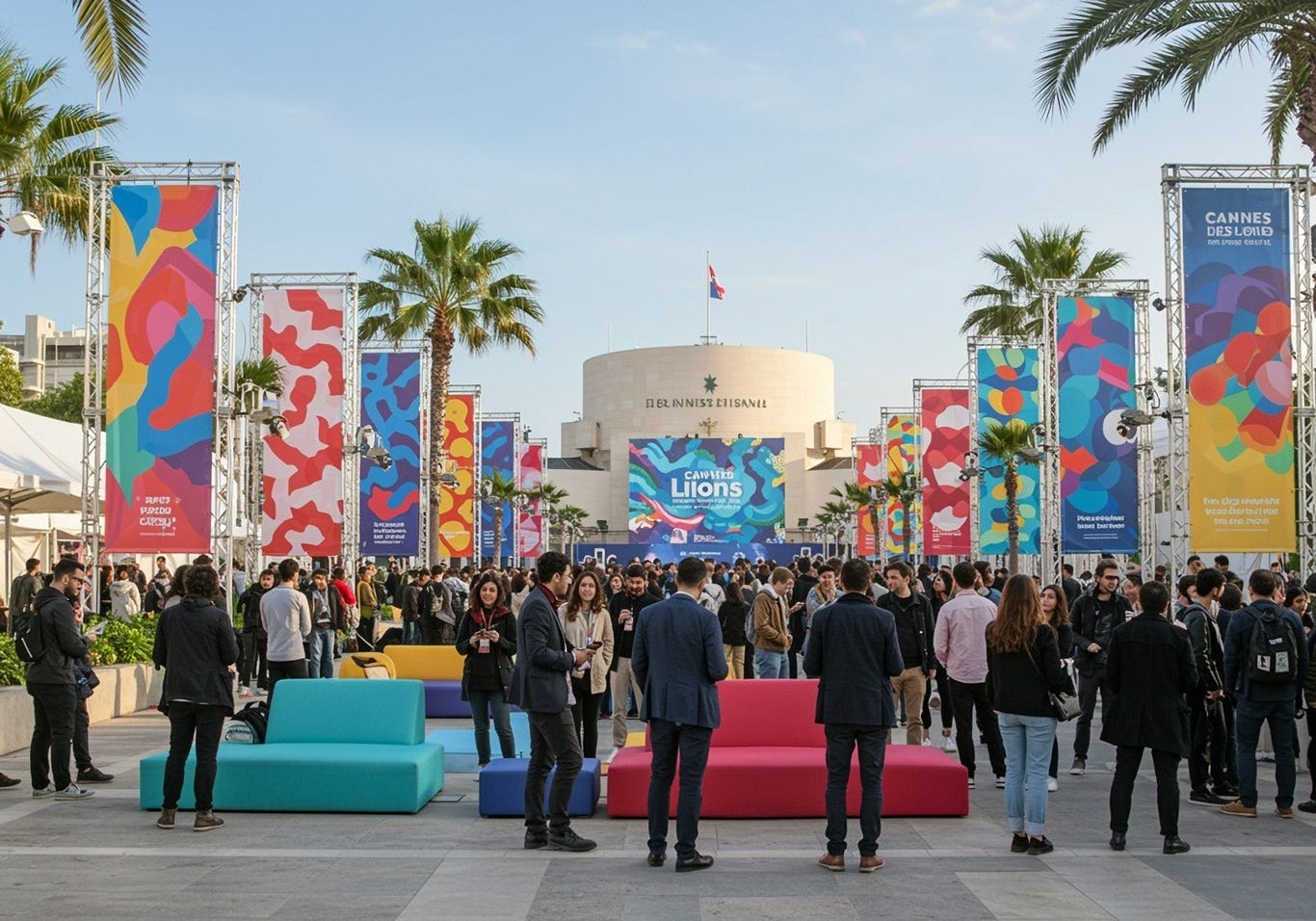
Last week, the skies above Cannes became a canvas as drones lit up the French Riviera above the Croisette — giant words and shapes floating in the night air, including, inevitably, the letters “AI”.
At the same time, the beachfront filled with lavish activations all courting the same brand leaders, and creators talked openly about what AI brand deals were now worth. And somewhere between the rosé and the panel sessions, Cannes Lions rolled out a new AI Craft subcategory across its craft Lions: proof that AI now has a permanent seat at the industry’s biggest festival.
The bar for AI creative just got raised — and most brands aren’t ready
Cannes added an AI Craft subcategory across its craft Lions — Design, Digital Craft, Film Craft, Industry Craft and Creative Data, but it’s no surprise that nearly all Grand Prix awards still went to works made by hand.

Apple TV's Design Grand Prix? A new logo built entirely from glass, filmed in-camera with coloured light reflected through it. Jury president Greg Quinton noted pointedly that "what could have been made far quicker … was made by hand." Coinbase's Film Craft Grand Prix, "Your Way Out," recreated a PlayStation-era video-game world on practical sets — printed costumes, low-poly masks, shadowless lighting — under a zero-CGI, zero-AI rule that director Oscar Hudson and production house MJZ treated as the entire point. De'Longhi won Industry Craft with "Tiny Coffee Shops," a painstaking set of handbuilt miniature cafés overseen by Simon Weisse, the model-maker behind The Grand Budapest Hotel.
The new AI Craft category signals something real, though. In 2026 the standard shifted: did AI change the outcome? It honours work where human creativity and AI combine to produce something neither could make alone, with craftsmanship and intent as the entry requirements, not just technical novelty.
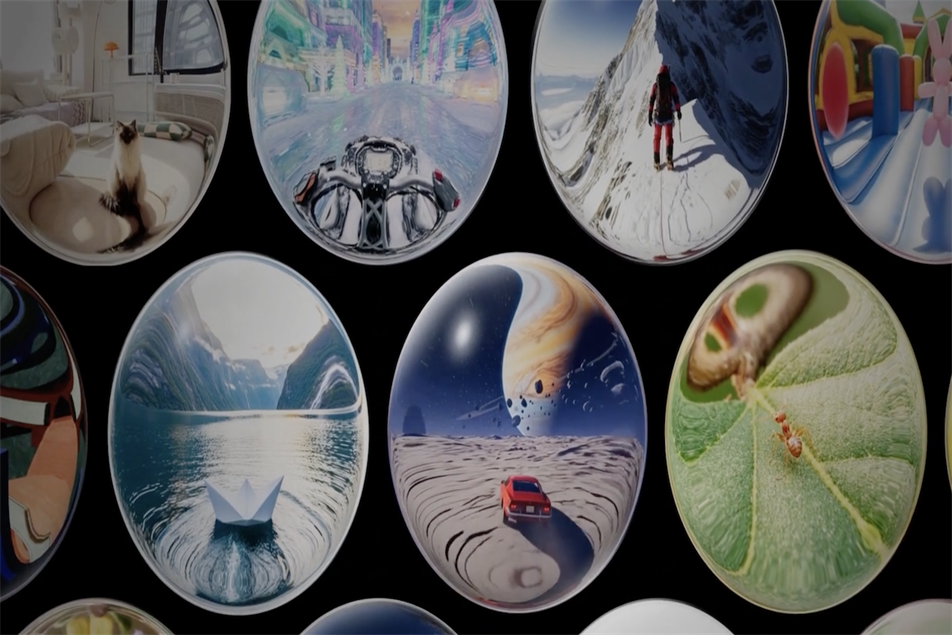
The one clear AI winner: Google’s “Project Genie” Digital Craft Grand Prix — illustrates exactly what that bar looks like. Project Genie lets users generate interactive, explorable worlds from a text prompt or a photo. The jury picked it because the AI unlocked a creative possibility that literally didn’t exist before.
That's the distinction hiding inside all the Cannes AI noise. AI didn't lose at Cannes 2026, average creativity did. Scott Galloway put it neatly from the Pivot stage: AI, he said, "takes everyone to the middle" — which is exactly why creativity matters more now, not less. The handmade work won because it was extraordinary, not because it was handmade. And the one AI campaign that won showed what the tool can do when it's treated as a genuine creative unlock rather than a production shortcut.
ChatGPT pitched itself as an ad channel — and the “consideration phase” framing is the most interesting part
This time last year, OpenAI had no ads business and no official interest in Cannes Lions. This year it arrived with a pitch advertisers will find hard to ignore — and, if they’re honest, harder to fully believe.
VP of monetisation Benji Shomair made the case: “this isn’t social; this isn’t display; and this isn’t search.” What ChatGPT offers, he argues, is access to a part of the purchase journey that’s never been properly addressable: the consideration phase, where people are actively researching options, comparing features, and deciding.
The ad unit itself, for now, looks like… an ad unit. But Shomair’s advice to early advertisers is telling: make it conversational, and use questions, because questions are what users are actually asking. That’s not a tweak to your existing creative. It’s a different brief entirely.
The skepticism is warranted. It’s been 19 weeks and the platform is still technically in pilot; launch pricing has already slid from a $60 CPM to as low as $25 in ten weeks. But the underlying behaviour shift is real — if people are genuinely deciding while they’re on ChatGPT, that’s a different kind of attention than social or search — and it deserves a different kind of creative.
AI agents won't kill brands. They'll just make weak ones easier to ignore.
This is where it gets interesting, and where Mark Ritson shared one of the most useful thinking of the week.
At Cannes, Ritson asked his AI agent for a drink recommendation. He got a confident answer — start with a Boulevardier, darker and warmer than a Negroni — and happily followed it down a rabbit hole of Campari-adjacent cocktails. The point wasn’t the drinks. It was the dynamic: a machine making a confident brand recommendation, and a person trusting it.
This triggered an old argument. In 2014, Simonson and Rosen published Absolute Value, predicting that perfect information — reviews, ratings, price comparison — would kill brand loyalty. Once consumers could objectively evaluate anything, brands as proxies for quality would fade. Marketing’s commentariat loved it. The death of the brand was confidently scheduled.
It didn’t happen. Reviews turned out to be gameable. People did not read 14 reviews before buying toothpaste — they bought the brand they’d heard of. Big brands dominated the very review averages meant to bury them.
Scott Galloway has been making a version of this case for years, and the line lands the same way every time: “the era of brand is over.” Agentic AI, the argument goes, is perfect diligence fully automated — no typing, no reading, no thinking. The brand premium evaporates, and the best actual product wins.
But here’s the problem: LLMs are not brand-blind. They’re brand-obsessed. When researchers test what large language models actually recommend, the same pattern keeps falling out — they favour the well-known. The brands that appear most often, most favourably, in the most places across the web are the ones the model has effectively been taught to trust. Fame isn’t a soft asset to an LLM. It’s the data.
A whole industry is already forming around this. “Share of model” is the new “share of voice” — where do you rank when the machine names a brand unprompted? And the arithmetic is more brutal than search. Search gave you ten links and a scroll. The agent gives you one answer, maybe three. You’re the answer, or you’re invisible.
The implication is uncomfortable but clarifying: AI won’t punish strong brands. It’ll punish weak ones — the me-too products that survived on shelf position and media noise. If your brand isn’t famous enough to show up in an LLM’s training data with weight and credibility, the agent is indifferent to you.
Which means the boring, long-game stuff — content, earned media, consistent presence, reviews — is now effectively training data for the next generation of purchase decisions. Brand-building just got a new ROI argument.
The AI;DR
Elsewhere in the AIverse
ChatGPT is about to stop being just a chatbot. OpenAI is reportedly building its biggest overhaul since launch — a “superapp” that bundles Codex, AI agents, image generation, and third-party tools into one ChatGPT, landing in the coming weeks.
The image-model leaderboard got a reshuffle. Reve 2.0 ditches the usual prompt-and-pray approach for a code-based layout you can fine-tune detail by detail and the model just knocked Nano Banana 2 down a spot on Arena rankings, making it the No. 2 image model overall.
Oracle’s earnings are a good news/bad news AI story in one chart. Revenue hit $19B for the quarter and the backlog exploded 363% to $638B — both ahead of expectations. The stock still dropped earlier this month, because Oracle also said it needs another $40B in financing to keep building data centers. Translation: even the companies winning the AI infrastructure race are starting to spook investors with how much the race costs.