

I was recently in a conversation with a group of tech marketing leaders. The discussion was supposed to be about AI strategy, but it quickly became something more uncomfortable: a candid reckoning with what’s happening to marketing talent — and what marketing teams actually need to do about it
The split is already happening
One thing that came through clearly: marketing teams are at wildly different stages of the AI journey — from basic LLM prompting to agentic workflows with embedded brand voice. And the gap between early adopters and everyone else is widening fast.
That matches what I see more broadly. 88% of marketers are using AI tools in their daily work, but only 21% of B2B leaders feel confident they’re using it effectively — and the #1 barrier is lack of in-house skills, not budget.
Sounds like we’ve got near-universal adoption with near-zero confidence.
The people I spoke to put it more directly: AI is a paintbrush, but the painter still needs to learn how to use it. Most teams haven’t done that learning yet. And the ones who have are pulling ahead.
So… what’s happening to the role of the marketer?
Fundamental roles are being questioned. Will there still be designers and content marketers in five years? Graphic designers and copywriters are already being asked to prompt and train the models that may eventually replace them. Obviously, people aren’t exactly motivated to do that.
It’s a real culture problem. You can’t build AI fluency across a team if people feel like they’re building the thing that’ll end their job.
As AI takes on more execution, humans are expected to focus on strategy, direction, and outcomes — while intelligent systems handle activation, testing, and optimisation. On paper, that’s a promotion, but in practice, it means the execution skills many of us spent years building: writing copy, pulling reports, setting up campaigns, are being commoditised faster than we can replace them with something better.
The consensus from that conversation: the most valuable hire right now is someone who can adapt to change. “Multi-threaded” generalists and T-shaped specialists who can act as orchestrators of AI agents. Not someone who’s great at one thing someone who can direct systems across multiple functions.
The winning profile is depth in something real, combined with enough breadth to work across the AI toolchain.
The APAC opportunity for marketers
Skills shortages affect 77% of APAC employers, with sales and marketing ranking as one of the hardest categories to fill. We’re already in a scarcity environment. Add AI disruption and it’s not just a skills gap — it’s a skills chasm.
But something interesting came up in the conversation: localisation and market expansion emerged as one of AI’s clearest advantages in the region. Campaigns can be adapted and scaled across markets faster than ever. That’s a genuine unlock for APAC roles where you’re often running across five languages, ten regulatory environments, and wildly different consumer behaviours simultaneously.
That said, the marketer who’s genuinely valuable in APAC isn’t just AI-fluent in general. They’re AI-fluent with regional judgment.
The thing AI still can’t do
One common consensus is that AI isn’t quite ready to own branding just yet. Human insight, voice of customer, and taste remain the necessary foundation, and cutting agencies in favour of AI-generated branding isn’t yet sustainable at scale.
There’s also a concern worth naming: over-reliance on AI risks atrophying the craft skills that make great marketing possible. Critical thinking. Creative instinct. The ability to read a room. If junior marketers skip the learning phase because AI can do the output, they never build the judgment that makes the output good.
Marketers with strong strategic thinking skills now command 34% higher salaries than tactical specialists. That gap is new. The market is already pricing in what AI is replacing.
What adapters might look like
I want to resist painting a neat before/after, because the reality is messier. But some patterns are clear:
They’ve changed what they spend time on. Not just added AI to an existing workflow, but actually cut things. Moved from producing content to directing it. From executing campaigns to designing the logic behind them.
They’ve developed a POV on quality. Anyone can generate copy with AI. Fewer people can tell immediately when it’s wrong: when the tone is off, the nuance is missing, the brand voice has slipped. That editorial judgment is a skill, and it compounds.
They’ve stopped waiting for their company to train them. This is perhaps the most important one. Only 25% of workers receive formal AI training from their employers: even as skills in AI-exposed roles are evolving 66% faster than other jobs. The adapters aren’t waiting for a curriculum. They’re running experiments and building their own framework.
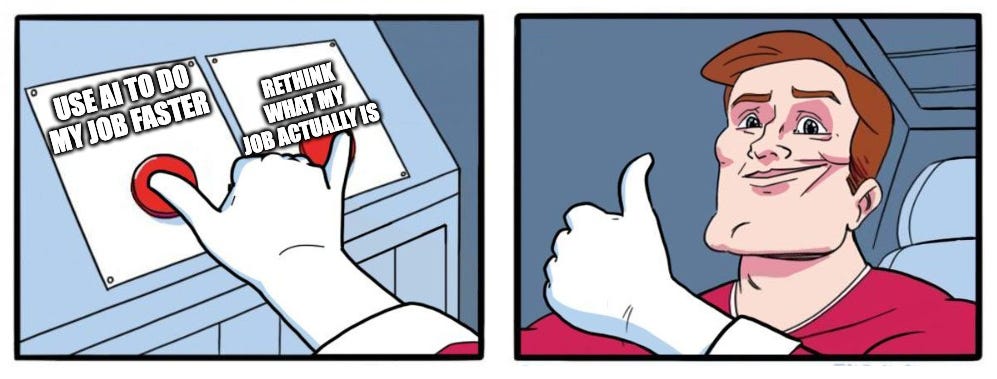
The non-adapters, by contrast, share one trait: they’re treating AI as a productivity tool rather than a structural shift. Using it to do the same job faster, not to do a fundamentally different job.
The new job description
The marketer’s role is now evolving toward orchestration. Setting the creative and strategic direction that AI executes. And that means the whole team needs to follow, because you can’t orchestrate a system you don’t understand.
If you ask me, the priority right now is building AI fluency across teams. Fluency means everyone in the function understands enough to work with AI intelligently, not just alongside it.
AI amplifies great marketers. It doesn’t replace the need for taste, judgment, and human insight. But it does raise the floor. Average execution is being automated. What’s left, and what’s actually valued, is the stuff that was always hard to teach.
The AI;DR
Elsewhere in the AIverse
OpenAI puts its coding agent in your pocket. Codex — OpenAI’s agentic coding tool — is now built directly into the ChatGPT mobile app, syncing across devices so you can kick off a task and walk away. The so what: for marketers building or managing AI workflows, the barrier to running agentic tasks just dropped again.
Tavus launched Image-to-Replica. Drop in a still image, brand mascot, or illustration, and it becomes an interactive digital human that watches, listens, and responds in real time. The creative bar for “good enough” video is moving fast — which is either exciting or terrifying depending on how much your brand relies on authentic human presence.
Ineffable Intelligence just landed an engineering partnership with Nvidia. Hot off a $1.1B seed round at a $5.1B valuation. The startup founded by DeepMind alum David Silver is building AI that learns through trial and error rather than human-written training data.