


👋 Quick-catchup: In Part 1, I ran a visibility test: four prompts asking AI to recommend the best APAC B2B marketers, and my name came up all of zero times. That result became the brief for a personal branding agent built on Claude Code: a workflow that takes raw reflection and routes it through a structured identity layer before generating anything.
If you missed Part 1, read it here first. If you’re caught up — here’s the full build.
🗂️ The workflow: layer by layer
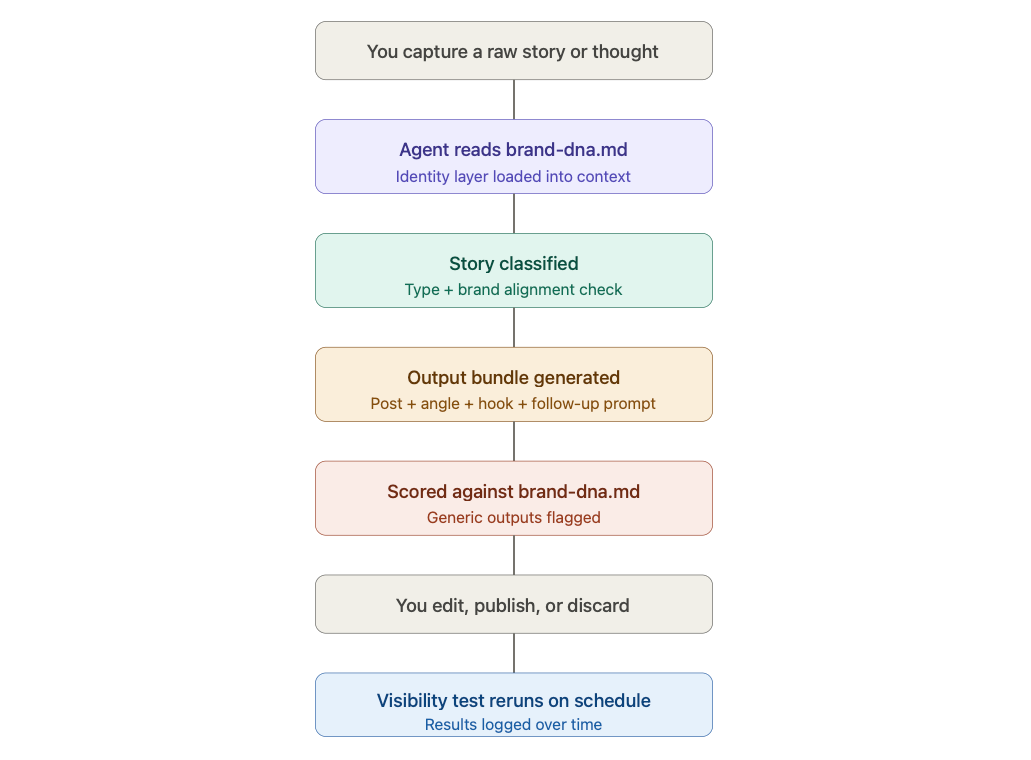
The agent runs across four layers. Think of them less as sequential steps and more as nested dependencies, and each layer only works because the one before it exists. I’ll tell you what’s built, what’s still in progress, and what’s planned.
🧬 Layer 1: The Identity Foundation
Everything starts here. Before the agent generates a single word, it reads a file called brand-dna.md — a persistent context file that makes every output yours rather than generic.
I kicked it off with this prompt in Claude Code:
Create a file called brand-dna.md with the following sections:
- Core belief (the one thing I want to be known for e.g. APAC B2B marketing leader in fintech, tech, SaaS)
- Contrarian positions (what I believe that most in my field don't)
- Niche language (specific terms my audience uses)
- Content pillars (topics I cover and why)
- Voice notes (what I sound like vs what I don't)
- Anti-patterns (topics, tones, formats to avoid)
Claude Code scaffolded the file. I filled it in manually, which is important — you don’t want AI inventing your positions and skills for you.
Pro tip: you won’t want to skip this step, even if takes some time to think about. Most people have a vague sense of their personal brand but have never written them down as explicit, falsifiable statements.
“I believe AI is changing marketing” is not a position. The agent is only as opinionated as what you give it.
The file never gets auto-updated. You edit it yourself when your thinking evolves. That’s a feature, not a limitation, since your identity wouldn’t and shouldn’t shift every time you have a new idea.
📥 Layer 2: Story Capture
The input layer. One prompt, no polish required:
What happened this week? What did you notice, hear, experience,
or think about that you haven't seen anyone else write about yet?
Anything you experienced at work or saw on LinkedIn. Stream of consciousness is fine. The agent takes it from there.
After you submit, it does four things:
Classifies your input into one of four types: Observation (pattern you noticed), Experience (something that happened to you), Reaction (response to something external), Contrarian Take (position against prevailing wisdom in your field)
Writes a one-line summary
Flags which positions in
brand-dna.mdthe story connects toFlags if it doesn’t connect to anything: either a new position worth adding, or content that’s off-brand
Here’s the prompt I used to build this layer:
Build a simple CLI input that captures free-text from me. After I submit,
classify it into one of four types: Observation, Experience, Reaction,
or Contrarian Take. Output the classification and a one-line summary.
Read brand-dna.md before classifying — the classification should be
informed by my stated positions.
Classification sounds like a small thing, but it really isn’t. Reactions are timely with have a shelf life. Observations are evergreen and they compound. Knowing which you’re working with changes how you write the output and when you publish it, and getting that call right early saves a lot of second-guessing later.
✍️ Layer 3: Output Generation
One story, four assets. From a single classified input, the agent generates:
LinkedIn post draft — under 150 words, first-person, no filler openers, hashtags optional
Newsletter angle — one paragraph on how this becomes a full issue, including which content pillar it fits.
Content hook — one punchy line that could open a carousel, Reel, or cold LinkedIn post
Follow-up prompt — one question to sit with before publishing anything
The prompt structure:
Given the classified story and brand-dna.md, generate the four outputs below:

LinkedIn post draft — under 150 words, first-person, no filler openers, add hashtags

Newsletter angle — one paragraph on how this becomes a full issue, including which content pillar it fits.

Content hook — one punchy line that could open a carousel, Reel, or cold LinkedIn post

Follow-up prompt — one question to sit with before publishing anything

Constraints: Every output must reflect at least one position from brand-dna.md.
If it doesn't, flag it and explain why. Do not soften my positions to make
the content more palatable. Do not use "I'm excited to share" or any variant.
Add hashtags for LinkedIn.
That flag constraint is the most useful thing in the whole system. In testing, about a third of first-draft outputs get flagged as not reflecting any stated position, which is the agent telling you the story you captured wasn’t specific enough to carry your identity. Better to know before publishing than after, amiright?
What I’m still finishing: a push-back function. If a generated output actively contradicts something in brand-dna.md — not just ignores it, but goes against it — the agent argues back rather than just flagging. It’d work when the contradiction is explicit with subtler inconsistencies, but it’s not reliable enough yet.
🔁 Layer 4: The Visibility Feedback Loop
The slowest layer — and the most important one to get right.
On a weekly or fortnightly schedule, the agent reruns the four visibility test prompts from Part 1 and logs the results to a file. Over time you’re tracking whether:
Your name starts appearing in AI-generated expert lists
The language AI uses to describe your niche matches your own niche language
Your stated positions are being reflected back in any form
I’ll be real, though. You won’t see movement in a week. Probably not in a month. But it’s the right signal to track if the goal is AI recognisability, not just content volume or follower count.
Technically, this is the simplest layer to build. The harder part is deciding what “progress” looks like in a way that’s honest rather than self-flattering. A name appearing once in one tool is good, but not exactly a signal. Your name appearing consistently across tools, in response to different prompts, over time, that’s what you’re looking for.
🗺️ The Full Flow
You capture a raw story or thought
          ↓
Agent reads brand-dna.md
          ↓
Agent classifies the story
(type + brand alignment check)
          ↓
Agent generates output bundle
(post + newsletter angle + hook + follow-up prompt)
          ↓
Agent scores outputs against brand-dna.md
(flags anything generic or off-position)
          ↓
You edit, publish, or discard
          ↓
[On schedule] Visibility test reruns
Results logged for tracking over time
3 things I didn’t expect
Yup, writing my identity file was the hardest part. Writing clear, falsifiable positions forces a clarity that most personal branding exercises actively avoid. Vague positioning feels safer, but your agent won’t work with vague, not well at least. If you take nothing else from this series, take that.
Classification is a more useful editorial instinct than I expected. When the agent tells you your story is a Reaction rather than an Observation, it shifts how you write the output and when you publish it. I’ve started applying the same classification mentally even when I’m not using the agent. That’s a sign the framework has some legs beyond the tool itself.
Generic outputs are information, not failure. When the agent flags a draft as not reflecting any stated position, most of the time it’s right. The story wasn’t specific enough to carry your identity. The flag is the feature.
Where this lands
Thanks for following along! This started as a build log and ended up being as much about the thinking behind personal branding as the technology inside the agent.
My build isn’t finished, but the core of the framework works. Capture, classify, generate, score. 10 minutes of raw input, a usable draft on the other side, calibrated to positions I’ve actually stated rather than generic best practices. That gap I talked about in Part 1 — between the thinking and the publishing — this closes it. Not perfectly, but consistently enough to matter.
Want to create one of your own?
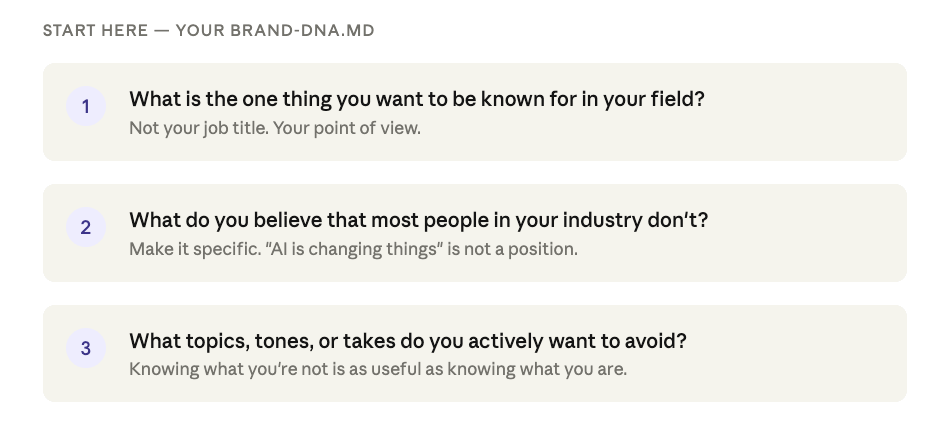
You don’t need Claude Code to begin — not exactly. The most valuable part of this entire system is the one that requires no technology at all.
Open a blank document right now and answer these:
What’s the one thing you want to be known for in your field?
What do you believe that most people in your industry don’t?
What topics, tones, or takes do you actively want to avoid?
That’s your brand-dna.md. Even if you never build the agent, having those answers written down and visible changes how you write, what you publish, and what you say no to. Everything else in this framework is just automation built on top of that clarity.
The AI;DR
Elsewhere in the AIverse
Poke raises $10M to build AI agents for your personal life. Text it to plan your schedule, track fitness, edit photos, manage your day. Fresh funding at a $300M valuation suggests there’s a real market for the personal side of agentic AI.
Meta introduces Muse Spark from its new Superintelligence Labs. The first in the Muse family of models, built as a natively multimodal reasoning model with tool-use, visual chain of thought, and multi-agent orchestration.
Claude now lets anyone build and deploy custom agents. Claude Managed Agents launched in public beta this week. Define your agent’s tasks, tools, and guardrails; Claude handles the production infrastructure.