

For a while now I’ve been meaning to sit down and write about how and why I use AI tools for marketing. This new series looks at a different AI tool each time and my experimentations, starting with Perplexity. Let’s dive in!
I don’t know about you, but I used to spend at least 10 hours a week doing research.
Competitive intelligence. Customer backgrounds. Market trends. Content topics. Fact-checking dubious LinkedIn stats. It’s a significant chunk of my week, and the workflow is... messy.
Sometimes it’s Google for 15 minutes, ChatGPT for context, back to Google to verify what ChatGPT just made up, LinkedIn stalking, company websites, back to Google. Repeat until I have what I need.
Enter Perplexity.
The promise: A research tool that combines search, AI, and citations in one place. Real-time information (unlike ChatGPT). Actual sources (unlike ChatGPT). No hallucinations (allegedly).
The question is, can it replace your current Google + ChatGPT + manual verification workflow?
So what is Perplexity?
Perplexity is an AI-powered research tool that searches the web and synthesises answers with citations. The free version gives you basic searches, while Pro ($17/month) adds things like unlimited “Pro” searches (more advanced AI model), file uploads and analysis, API access to multiple models (GPT-4, Claude, etc.), and better source diversity.
Basically, it’s Google + ChatGPT + Research Assistant, rolled into one. The hypothesis for my test was that Perplexity can reduce my research time by 40-50% while maintaining quality.
What I’ve been using it for:
Guest research for this newsletter - Background on people I want to interview. Company info, recent work, LinkedIn activity, why they’d be interesting.
Topic validation - Is this newsletter idea actually interesting or just something I think is clever?
Competitive intelligence at my marketing job - What other competitors are doing. Positioning, recent campaigns, how they talk about themselves.
Market trends - What’s happening in B2B marketing + AI in APAC. Not just “what everyone’s talking about” but “what’s actually shifting.”
Fact-checking - Verifying the AI marketing stats that get 5k likes but feel made up.
Use case 1: Content ideation for the newsletter
The situation: I needed to figure out if “Why AI makes B2B marketing more human” was actually an interesting angle or just something I thought sounded clever. I also needed 3-4 backup topics in case my first choice fell flat.
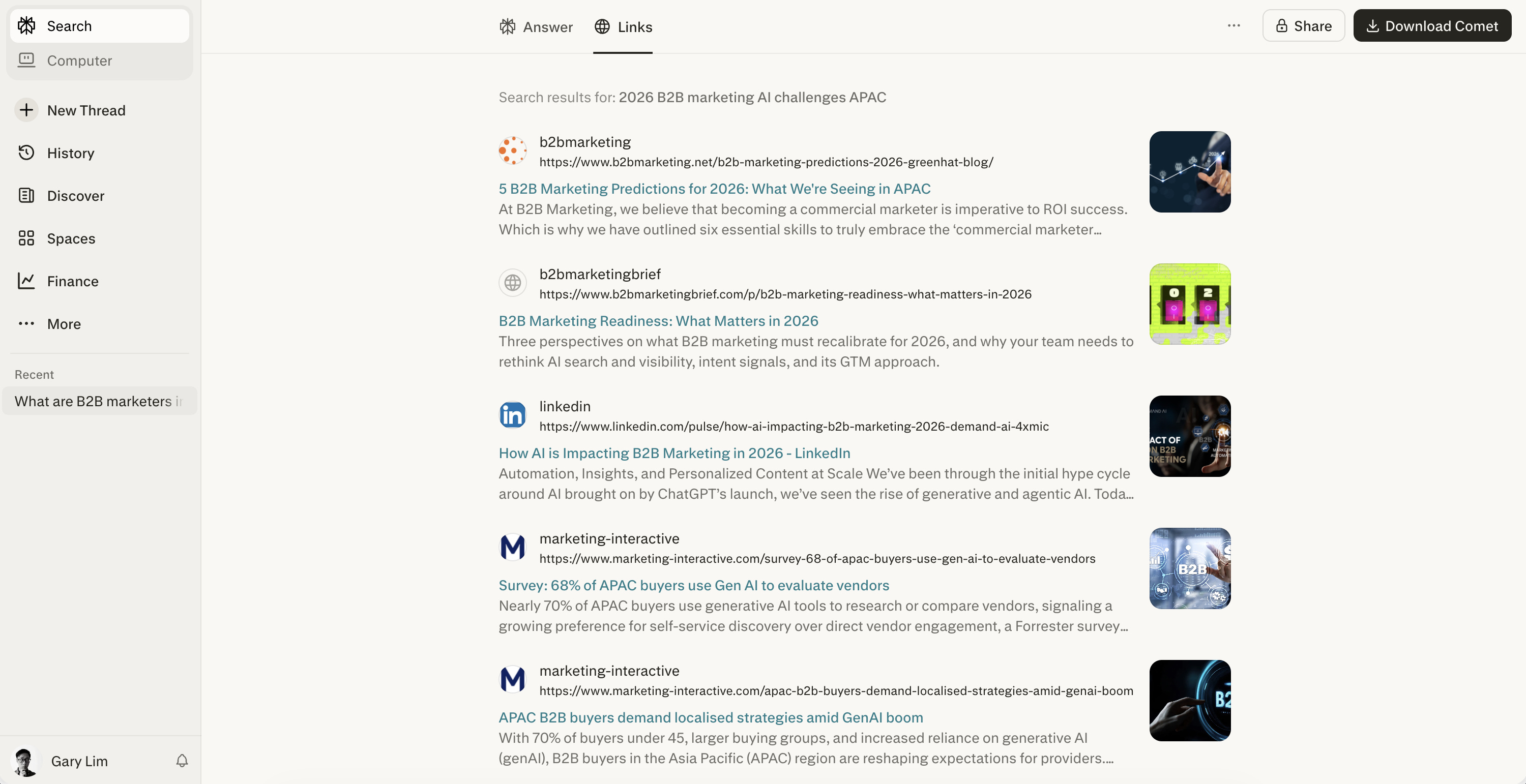
What I asked Perplexity: “What are B2B marketers in APAC struggling with regarding AI in 2026? Recent pain points, trending discussions, emerging challenges”
What I got was a mixed bag. Perplexity surfaced several real pain points: ”proving ROI on AI tools,” “maintaining brand voice with AI-generated content,” “team adoption challenges” — all legitimate topics people are talking about. It pulled from recent marketing publications, LinkedIn trending topics, and industry reports.
Time: 16 minutes total, including follow-up queries to try to get APAC-specific insights rather than more Western-centric reports
Old method: 45 minutes of LinkedIn scrolling, reading comments on popular posts, checking what marketing communities in Singapore and Jakarta are discussing.
The reality is Perplexity gave me solid topic validation — ”AI and brand voice” is clearly something people care about — but the regional nuance I needed a bit more prompting. I ended up using Perplexity to identify broad themes, then validating APAC relevance.
Use case 2: Fact-checking stats
The situation: I’ve been collecting AI marketing statistics from LinkedIn – the kind that get 5,000 likes and feel suspiciously made up. “87% of marketers report AI increased productivity.” “AI reduces content creation time by 73%.” “Only 12% of B2B companies have an AI strategy.” I needed to know if these were real.
What I asked: For each stat, I’d query “Verify statistic: [exact stat and claim] - find original source and study methodology”
I tested 10 statistics. Perplexity verified 6 correctly, found original sources for 4, and flagged 2 as unsourced. The 4 it couldn’t verify? Those were the ones being shared the most on LinkedIn. Turns out people love quoting statistics that don’t exist. One widely-shared stat about “AI adoption in B2B” traced back to... a single tweet from a marketing influencer. No study or data, just a confident assertion that got screenshotted and spread.
Time: About 2 minutes per stat, 20 minutes total
Old method: 5-7 minutes per stat manually Googling, trying to trace back to original source, often hitting dead ends
The citations were legitimate when they existed. Perplexity would surface the original study, publication date, sample size, methodology. When sources didn’t exist, it would say so — unlike ChatGPT, which would confidently invent a plausible-sounding study. This is probably Perplexity’s strongest use case for me. It’s significantly faster than manual verification and hasn’t hallucinated sources yet.
Use case 3: Competitive intelligence
The situation: For my fintech event marketing role, I needed to research two competing events in the region. What’s their positioning? Recent campaigns? How do they talk about themselves on their websites and LinkedIn?
What I asked: Separate queries for each event — ”[event name] APAC fintech events - positioning statement, recent campaigns, how they differentiate”
Both events are well-established with plenty of web coverage — press releases, speaker announcements, LinkedIn posts from past attendees, tech media coverage. Perplexity aggregated all of it efficiently. For Event A, I found their focus on institutional finance (banks, wealth management), keynote speakers from DBS and UOB, estimated 800+ attendees based on LinkedIn posts from 2024, and a clear B2B networking angle. For Event B, the positioning skewed toward fintech startups and innovation (VCs, founders, early-stage), speakers from regional startups and accelerators, smaller but more intimate format (~300 attendees), and a pitch competition component.
Time: 12 minutes for both companies
Old method: 35-40 minutes (visiting each event website, reading past coverage, LinkedIn stalking previous attendees, checking speaker backgrounds)
What made this work was that both events are large enough to generate consistent web coverage. Every speaker announcement gets a press release. Past attendees post on LinkedIn. Tech publications cover the event. Perplexity had plenty of current, high-quality sources to pull from.
Use case 4: Topic validation
The situation: Before committing to “AI making B2B marketing more human” as my first newsletter topic, I wanted to validate that it was actually interesting—not just something I thought was clever.
What I asked: “Are B2B marketers discussing how AI creates more time for customer relationships rather than less? Recent trends 2025-2026”
Perplexity found several articles and discussions about AI freeing up time for strategic work, including a few that specifically mentioned increased customer interaction. The trend was real — people are talking about this.
Time: 8 minutes
Old method: 20-30 minutes scrolling LinkedIn, checking marketing Slack communities, reading recent articles
The value here was speed. Perplexity quickly confirmed the topic had traction.
What I’m learning a week in
Where it actually saves time:
Fact-checking is the killer use case. This is where Perplexity clearly beats my old workflow. Two minutes to verify a stat vs. 5-7 minutes of manual Google detective work. And it either finds the real source or tells me there isn’t one — unlike ChatGPT, which would invent a plausible study.
Competitive intelligence for well-covered companies. When researching the two fintech events, Perplexity was genuinely impressive. Twelve minutes got me everything I needed — positioning, speakers, audience, reviews — because both events had strong web presence. This is where it shines: entities with consistent online coverage.
Content ideation gets faster. Fifteen minutes to validate that “AI and brand voice” is a real concern vs. 45 minutes of LinkedIn scrolling. It’s good at surfacing what’s trending broadly, even if it can’t tell me if it matters in Singapore specifically.
No more tool-hopping. Not bouncing between Google, ChatGPT, LinkedIn, and verification tabs makes the whole process feel less chaotic. Everything’s in one place.
Where it falls short:
Struggling with local, specialised APAC research. For Singapore, Jakarta, Manila—anywhere outside the US and Europe—Perplexity defaults to Western sources talking about “global trends.” If my newsletter was focused on US B2B marketing, this wouldn’t matter. But it’s not.
The sources exist — regional marketing publications, local tech blogs, LinkedIn groups— but Perplexity doesn’t surface them. Google with geographic filters still wins here.
The pattern is clear. Large, well-covered entities (major events, big companies) = Perplexity works great. Smaller regional players with limited web presence = outdated or incomplete information. But this is not so much a tool problem as it is a data availability problem.
Topic validation only goes halfway. Perplexity confirmed that “AI making marketing more human” was trending. What it couldn’t tell me: Does this resonate in APAC? Is this a US observation or a universal shift? I still needed LinkedIn and local communities to validate regional relevance.
What I didn’t expect:
Follow-up queries work better than Google. Being able to refine conversationally ”Now show me Singapore-specific sources” or “Focus on 2025-2026 only” — is smoother than rebuilding a Google search query.
It’s honest about missing sources. When I fact-checked those LinkedIn stats, Perplexity said “no source found” for the ones that didn’t exist. ChatGPT would have invented a study. That honesty matters.
The web coverage threshold matters. I’m learning to predict when Perplexity will work well: Does this entity generate regular online content? Are there multiple recent sources? If yes, Perplexity excels. If no, expect gaps or stale data.
The AI;DR (elsewhere in the AIverse)
Meta’s Smart Glasses privacy lawsuit — Meta got hit with a class action lawsuit over Ray-Ban AI glasses. Contractors in Kenya were viewing users’ intimate footage—bathrooms, bedrooms, the works. Marketing said “designed for privacy” while personal videos went to overseas workers.
Luma launches creative AI agents — New “Unified Intelligence” models that handle entire creative briefs—text, images, video, audio. Give it a product photo and 200-word brief, get full ad campaign concepts. Interesting for multi-format content, but skeptical about brand voice and regional nuance.
Raycast’s just announced Glaze — Build native Mac apps just by describing them. No coding. Runs locally, works offline, $20/month. Could be useful for custom marketing tools—event trackers, competitive dashboards. Question: Will AI-generated apps be reliable for daily use?
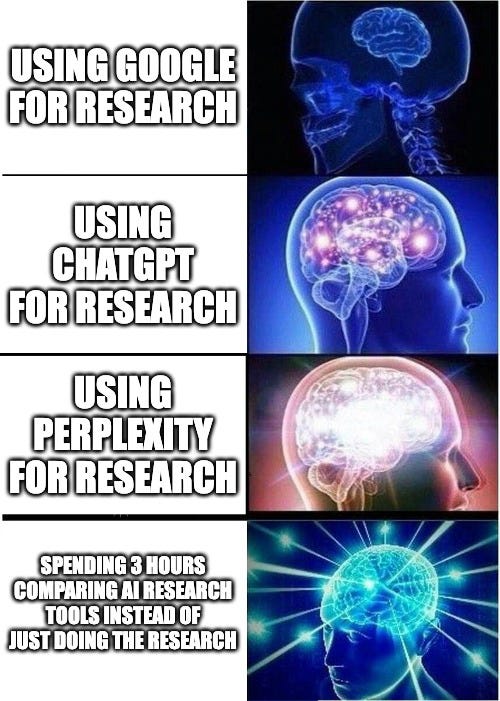
Meme of the week
P.S. If you're using Perplexity (or tried it and quit), I'd love to hear your experience. What worked? What didn't? Reply and let me know!