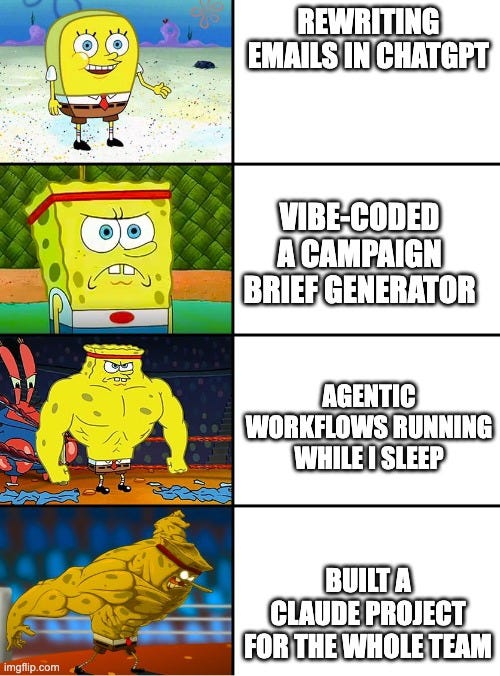
Earlier this week, Zapier’s co-founder and CEO Wade Foster dropped something worth paying attention to: an AI Fluency Rubric — the framework they use for every single hire, focused on what candidates have actually built, covering every department — sales, product, engineering, and yes, marketing.


It's a sharp framework. And it got me thinking about what AI fluency looks like on the ground in the day-to-day reality of how marketing teams adopt and build with AI.
Because the gap between “I use AI” and “I build with AI” is enormous. And most teams are still on the wrong side of it.
After watching marketers across the industry grapple with this, I’ve started to see a clear pattern. When it comes to using AI for marketing, there are four distinct levels, each one requiring a stronger skill set, a different mindset, and a different kind of patience.
You can’t skip the climb. But trust me, once you see the steps, it gets a lot less daunting!
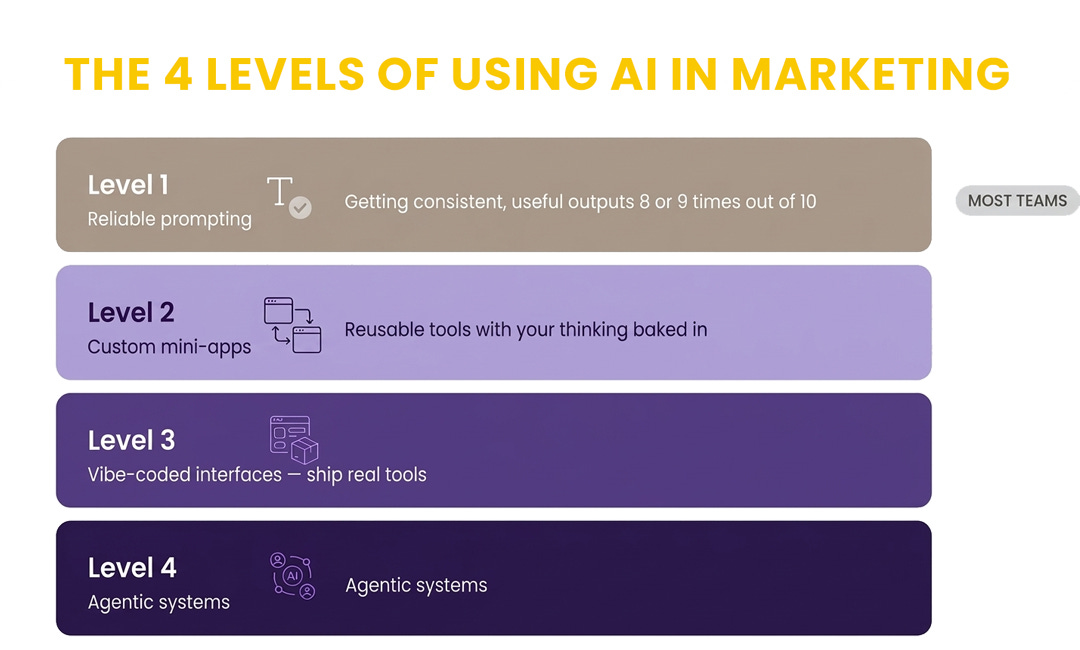
🪜 Level 1: Reliable Prompting
What it looks like: Your team uses ChatGPT or Gemini like a slightly smarter Google. Results are inconsistent. There’s no shared practice. Some people swear by it; others quietly gave up after a few bad outputs and went back to writing everything themselves.
What it actually is: The foundation. And most people rush through it without really building it.
Level 1 isn’t just “using AI.” It’s learning how to get AI to give you useful, consistent outputs eight or nine times out of ten. That’s harder than it sounds — especially for marketers who are used to tools that behave predictably. AI doesn’t work like that. It’s non-deterministic, which is a fancy way of saying: same input, different output, every single time.
Which means the right question isn’t “is this output correct?” It’s “did this output make my thinking better?”
The way to get better at this level isn’t to try more tools. It’s to take one task — rewriting a campaign brief, drafting a nurture email, summarising a competitor’s positioning — and iterate on it inside a single conversation until the output is dramatically better than where you started. Add context. Push back on bad answers. Figure out that the AI responds differently depending on how you frame the problem.
What good looks like at Level 1:
You’ve stopped asking “is this right?” and started asking “did this make my thinking better?”
You know how to layer in context — brand tone, audience details, past examples — to meaningfully change the output
You don’t quit after a bad first response (the marketing equivalent of not scrapping a campaign because the first concept missed)
The self-check: If your team’s AI usage is mostly one-off prompts with no shared practices, you’re here. That’s fine. Own it. Everyone starts here.
🔧 Level 2: Custom Mini-Apps
What it looks like: Someone on the team has built a custom GPT, a Claude Project, or a Gemini Gem that others actually use. There are emerging patterns — “this is how we handle X.”
What it actually is: The most underrated level in the stack. Also the one where the real paradigm shift happens.
If Level 1 is learning to fish, Level 2 is building a rod that casts itself.
At some point, you’ll notice you’re typing the same instructions over and over. Same brand context. Same output format. Same three caveats about your audience every single time. That’s your cue. Stop copy-pasting yourself and save those instructions into something reusable.
Custom GPTs, Claude Projects, Gemini Gems — these aren’t just productivity hacks. They’re mini-apps with your thinking baked in, which means every conversation starts from a higher baseline. Every person on your team who uses that tool gets the benefit of the work you put in once.
It’s tempting to skip this and jump straight to building dashboards and interfaces. Don’t. The real goal of Level 2 isn’t the tool you build — it’s the systems thinking you develop in the process. That’s the muscle that makes everything else work.
What good looks like at Level 2:
You’ve built at least one reusable tool that solves a specific, repeatable marketing problem
Other people on your team use it — not just you
“How we do X with AI” is something your team can actually articulate
The self-check: If your team has built custom tools that others actually use, and patterns are starting to emerge around specific workflows, you’re here.
⚙️ Level 3: Vibe-Coded Interfaces and Automated Workflows
What it looks like: Someone on your team — not necessarily an engineer — has built an actual tool. A dashboard. An internal app. An automated workflow that handles a task end-to-end without anyone babysitting it.
What it actually is: Systems thinking with an interface on top.
This is the level that makes people think they need a computer science degree. They don’t.
“Vibe coding” is what happens when you describe what you want and let AI write the code — using tools like Replit, Lovable, Claude Code, or Cursor. The skill isn’t writing code line by line. It’s knowing how to decompose the problem, describe it precisely, and iterate with AI as your debugging partner when things inevitably break.
For marketers, this opens up genuinely exciting territory: a competitor monitoring dashboard that pulls from multiple sources, a campaign brief generator with your full brand playbook baked in, an automation that turns long-form content into a full distribution plan, a lead scoring tool built specifically around your ICP. Not off-the-shelf. Yours.
What good looks like at Level 3:
Someone on your team (not necessarily a developer) has actually shipped a working tool
You’re starting to work with APIs, documentation, and developer tools — as a non-engineer
Building and using software feel like different points on the same spectrum, not different worlds
The self-check: If someone on your team has built something that works — a dashboard, an automation, an internal app — even without an engineering background, you’re here.
🤖 Level 4: Agentic Systems
What it looks like: AI taking actions across multiple tools without a human signing off on every step. Data goes in. Something useful comes out. Nobody had to sit in the middle.
What it actually is: Where everything is heading. Where very few marketing teams actually are yet.
An agentic system is when AI stops being a tool you talk to and starts being a system that works on your behalf. It reads inputs, makes decisions, and pushes outputs — across platforms, across tools, across your stack.
For marketing, the early versions look like: a system that monitors brand mentions and flags anomalies before you’ve had your morning coffee. One that pulls campaign data from five different platforms and drops a clean performance summary into Slack every Friday. One that qualifies inbound leads and routes them to the right sequence without anyone touching them.
The unlock here isn’t programming. It’s decomposition — the ability to break any workflow into pieces small enough that each one can be handled by a single, well-scoped prompt. An agent is really just a series of Level 1 and Level 2 problems linked together. The agent handles the handoffs. You define the logic.
What good looks like at Level 4:
You have at least one end-to-end workflow running autonomously — data goes in, something useful comes out, no manual steps in between
Your team’s time is spent defining and refining the logic, not executing it
You’ve learned to pick problems carefully — high-volume, repeatable, low-stakes-if-wrong — because you know where AI still needs a human backstop
The self-check: If you have automated workflows where AI acts across multiple tools without a human sign-off on every step, welcome to Level 4. There aren’t many of you yet.
Where’s your team?
Here’s a quick self-assessment:
Level 1: Your team uses AI for one-off tasks. Results are inconsistent. No shared practices or standards.
Level 2: At least a few people have built reusable tools that the team actually uses. Patterns are starting to emerge around specific use cases.
Level 3: Someone has built a working tool — a dashboard, an automation, an internal app — even without an engineering background.
Level 4: You have automated workflows where AI acts across multiple tools without a human in the loop for every step.
Most teams are somewhere between Level 1 and Level 2. That is completely normal. The issue isn’t being at Level 1 — it’s thinking you’re at Level 3.
Teams that skip Level 2 miss the systems thinking that makes everything else work. They end up with a pile of disconnected tools, no shared practice, and a growing suspicion that AI hasn’t really delivered on its promise.
So how should you proceed? Pick one workflow. Get specific about what you need it to do. Save those instructions somewhere reusable. Then ask yourself: what’s the next small problem I can hand off to AI? What can I build next?
The AI;DR
Elsewhere in the AIverse
Both Google and Microsoft both dropped new models this week. Google released Gemma 4 — its most capable open model family, built for reasoning and agentic workflows, in four sizes. Microsoft countered with the MAI models, focused on transcription, voice, and image generation.
Brett Adcock came out of stealth with Hark. The founder behind Figure and Archer Aviation is building “personal intelligence” — advanced AI paired with next-gen hardware. His verdict on existing chatbots: “incredibly dumb.” Watch the launch video.
Claude now connects to work tools on mobile. Figma, Canva, Amplitude and more are now accessible inside Claude on your phone — the third Claude release this week, after Computer Use and Auto Mode. Busy week at Anthropic HQ.
Meme of the week