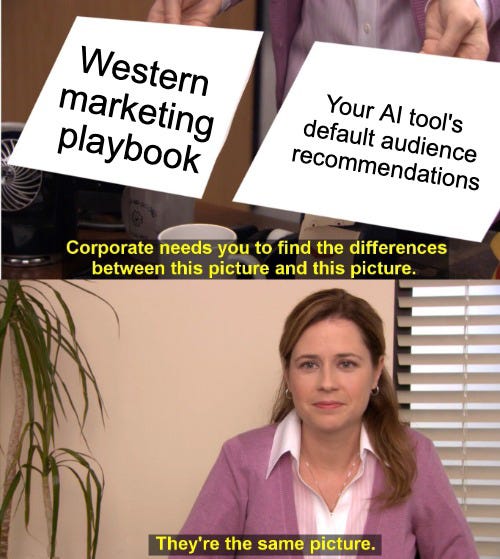

A few months ago, I wrote a piece for e27 about something that’s been bugging me as an APAC marketer: how Western marketing playbooks, particularly for startups, get copy-pasted into APAC markets without much interrogation — growth loops built for Palo Alto, messaging frameworks designed for English-first audiences, and distribution strategies that assume your customer has a credit card and 5G connection.
That piece wasn’t about AI, but lately I’ve been sitting with an extension of the same thought: what happens when those assumptions get baked into the model itself?
AI marketing tools learn from historical data: who clicked, who converted, who stayed. That data skews Western, urban, and English-literate, because that’s who’s been transacting online the longest. The underserved Asian audiences that APAC marketers are actually trying to reach are largely absent from that training signal.
I think marketers frame it wrong when they call it a bias problem. It’s actually a customer acquisition cost (CAC) problem.
The segments that AI tools tend to deprioritise are often less saturated, faster-growing, and — once you acquire them — stickier. When you’re the first brand to reach someone in their language, on their terms, with a product that actually fits their life, you don’t lose them easily to a competitor whose algorithm never found them either.
Look at something like GCash in the Philippines or GoPay in Indonesia. The dominant narrative around their growth tends to focus on product. But a significant part of what made them work was a willingness to reach customers that existing financial infrastructure and existing marketing logic had written off. The algorithm didn't find those customers. Someone made a deliberate choice to go looking.
Three things worth doing before you trust your tool's outputs
Ask where your tool was trained and pay attention to what it builds automatically.
Which audience segments does it construct automatically? Which ones do you have to build manually? The gaps between those two lists are the assumptions baked into the model.
Run a simple audit: pull your tool’s recommended audience and map it against your actual customer. If they don’t match, you need to decide how much of your budget you’re willing to spend proving the algorithm wrong before you take back control.
Seed your own first-party data early and deliberately.
The fastest way to correct for training bias is to give your algorithm better signal. That means running intentional campaigns into underserved segments. Not to convert immediately, but to generate behavioural data your tool can actually learn from.
This might look like: a small always-on budget for Bahasa or Filipino content, even when your primary market is English-speaking. Or a landing page variant built specifically for first-time digital finance users. Or a retargeting pool you build manually from offline events and community touchpoints, rather than letting the algorithm decide who’s worth following up with.
The startup that builds a proprietary data advantage in a segment their competitors have algorithmically abandoned is the one that wins the next three years.
Treat “low-converting segments” as hypotheses, not verdicts.
When your tool tells you a segment underperforms, the question isn’t “should I cut it?” The question is: why is it underperforming?
Work through it systematically. Is the creative wrong for that audience, built around visual cues, humour, or social proof that doesn’t translate? Is the landing page in a language they’re not comfortable transacting in? Is the call-to-action built around a behaviour your customer doesn’t have yet, like entering card details when your audience is used to paying via e-wallet or cash on delivery?
The algorithm can’t distinguish between “this segment won’t convert” and “this segment hasn’t been spoken to correctly.” It just sees low signal and pulls back. Only you can make that call. And the first time you isolate the real reason and fix it, you’ll often find a segment that was never actually underperforming.
In short, the algorithm will always find you a customer. The question is whether it's finding yours.
The AI;DR
Elsewhere in the AIverse
Adobe launches Photoshop AI assistant. The new assistant, available on Photoshop Web and Mobile, lets you edit images through natural language prompts. Public beta is live now.
Canva introduces Magic Layers. Flat JPGs and PNGs, including AI-generated images, can now be converted into fully editable, multi-layered designs. Move objects, edit text, change layouts.
Amazon opens Health AI to everyone. Previously limited to Prime and One Medical members, Amazon’s healthcare assistant is now available to all users on its website and app. One to watch for what it signals about AI moving into high-stakes, high-trust verticals.
Anthropic upgrades Claude for Excel and PowerPoint. The two tools now share full conversational context across open files — meaning Claude can update a spreadsheet, build a model, and drop the output into a pitch deck in one continuous workflow without losing context. The update also brings Skills to both apps.
Meme of the week